Thank you for your patience while we retrieve your images.
Uploaded 20-Jul-11
Taken 14-Jul-11
Visitors 76


1 of 44 photos
Thumbnails
Info
Categories & Keywords

Category:
Subcategory:
Subcategory Detail:
Keywords:11, 1842, Balcombe, Brighton, Cordoba, David, Designed, Europe, Haywards, Heath, John, London, Mocatta, Moorish, Ouse, Ouse, Restrick, River, Sussex, Urpeth, Valley, Viaduct, Viaduct, Victorian, achievement, arches, arches, architecture, architecture, balcombe, balcombe, ball, bold, bottom, brashness, brick, bricks, bridge, bridge, british, building, built, cathedral, cloud, combines, commuter, commuting, countryside, crystal, curve, depth, engineering, england, england, field, focusing, hyperfocal, landmark, landscape, line, mainline, million, mosque, of, of, perspective, perspective, rail, railway, railway, reminiscent, sussex, symmetry, to, towering, transport, uk, viaduc, viaduct, viaduct
Photo Info

Dimensions5757 x 1864
Original file size1.59 MB
Image typeJPEG
Color spacesRGB
Date taken14-Jul-11 09:31
Date modified21-Jul-11 08:43
Shooting Conditions

Camera makeNIKON CORPORATION
Camera modelNIKON D3X
Focal length24 mm
Focal length (35mm)24 mm
Max lens aperturef/2.8
Exposure1/400 at f/10
FlashNot fired
Exposure bias0 EV
Exposure modeAuto
Exposure prog.Normal
ISO speedISO 100
Metering modeCenter-weighted average
Digital zoom1x
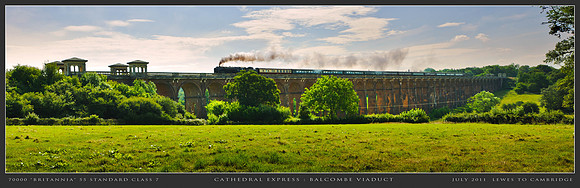
70000 Britannia was the first of 55 Standard class 7 engines to be built in Crewe by British Railways.

70000 Britannia was the first of 55 Standard class 7 engines to be built in Crewe by British Railways.

Completed in January 1951 she was built for express passenger services between London and Norwich. The BR Standard classes were designed by drawing on the best qualities from several previous locomotives to create an efficient engine that was produced with lower maintenance costs and weight saving measures to enable it to work across a wider geography. Britannia has 2 cylinders, 6 driving wheels and a firebox of 42ft2 with most of the motion situated on the outside of the frames for ease of maintenance. Whilst limited to 75mph the locomotive is capable of reaching speeds up to 100mph. For many years Britannia’s cab roof was painted white to commemorate her pulling the funeral train of King George VI from Sandringham to London in 1952. After 15 years of service in May 1966 Britannia was retired and after spells at preserved railways returned to the national network between 1991 and 1997 until major repairs were required and the locomotive was withdrawn for overhaul. In 2010 Britannia was steamed once more and 2011 marks the locomotive’s return to the main line after a 14 year absence.