Thank you for your patience while we retrieve your images.
Uploaded 14-Jul-11
Taken 14-Jul-11
Visitors 37


31 of 44 photos
Thumbnails
Info
Categories & Keywords

Category:
Subcategory:
Subcategory Detail:
Keywords:11, 1842, Balcombe, Brighton, Cordoba, David, Designed, Europe, Haywards, Heath, John, London, Mocatta, Moorish, Ouse, Ouse, Restrick, River, Sussex, Urpeth, Valley, Viaduct, Viaduct, Victorian, achievement, arches, arches, architecture, architecture, balcombe, balcombe, ball, bold, bottom, brashness, brick, bricks, bridge, bridge, british, building, built, cathedral, cloud, combines, commuter, commuting, countryside, crystal, curve, depth, engineering, england, england, field, focusing, hyperfocal, landmark, landscape, line, mainline, million, mosque, of, of, perspective, perspective, rail, railway, railway, reminiscent, sussex, symmetry, to, towering, transport, uk, viaduc, viaduct, viaduct
Photo Info

Dimensions5407 x 2030
Original file size1.46 MB
Image typeJPEG
Color spacesRGB
Date taken14-Jul-11 09:31
Shooting Conditions

Camera makeNIKON CORPORATION
Camera modelNIKON D3X
FlashNot fired
Exposure modeAuto
Exposure prog.Normal
ISO speedISO 100
Metering modeCenter-weighted average
Digital zoom1x
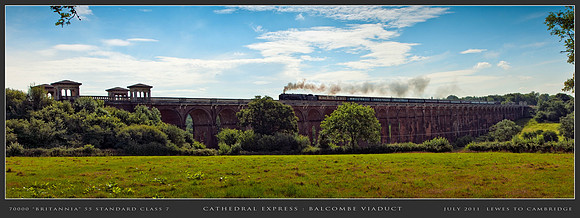
CATHEDRAL EXPRESS -BRITANNIA 70000 ON BALCOMBE VIADUCT

CATHEDRAL EXPRESS -BRITANNIA 70000 ON BALCOMBE VIADUCT

70000 Britannia was the first of 55 Standard class 7 engines to be built in Crewe by British Railways.

Completed in January 1951 she was built for express passenger services between London and Norwich. The BR Standard classes were designed by drawing on the best qualities from several previous locomotives to create an efficient engine that was produced with lower maintenance costs and weight saving measures to enable it to work across a wider geography. Britannia has 2 cylinders, 6 driving wheels and a firebox of 42ft2 with most of the motion situated on the outside of the frames for ease of maintenance. Whilst limited to 75mph the locomotive is capable of reaching speeds up to 100mph. For many years Britannia’s cab roof was painted white to commemorate her pulling the funeral train of King George VI from Sandringham to London in 1952. After 15 years of service in May 1966 Britannia was retired and after spells at preserved railways returned to the national network between 1991 and 1997 until major repairs were required and the locomotive was withdrawn for overhaul. In 2010 Britannia was steamed once more and 2011 marks the locomotive’s return to the main line after a 14 year absence.

BALCOMBE VIADUCT Built in 1841, the Ouse Valley Viaduct (also called Balcombe Viaduct) over the River Ouse on the London-Brighton Railway Line north of Haywards Heath and south of Balcombe is 1,475 feet (450 m) long, 96 feet (29 m) high and is carried on 37 semi-circular arches with pierced piers.
An extremely elegant railway viaduct that carries the London to Brighton main line over the River Ouse. It was designed by engineer John Urpeth Rastrick in association with the architect of the London to Brighton railway, David Mocatta. Construction completed 1842. The 11 million bricks needed for its construction travelled up the Ouse River (via Newhaven and Lewes) from Holland. It was restored in 1996. The structure is a Grade II listed building. The viaduct is still used, with around 110 trains a day passing over it on the Brighton Main Line. The viaduct's arches are semi-circular and constructed in red brick. Each spans 37ft. The piers are tapered both side and end-on and divided in two by 10ft wide weight-saving voids, which are capped by six-ring brick arches. Thus the whole has a slender appearance.

The parapets of Caen stone and take the form of classical balustrading. This stone is also used for string courses, pier caps and the two small italianate pavilions set at each end of the bridge. At its highest point, the bridge is 96ft above the river